24.10.2026
How to Choose an Executive Chair: Ergonomics & Style
Choosing the right executive chair is fundamentally about striking a precise balance between architectural prestige, certified ergonomic engineering, and enduring material craftsmanship. Rather than serving as a purely symbolic centerpiece behind a desk, an executive seat must protect spinal alignment throughout extended strategic meetings, administrative sessions, and screen-intensive workflows. Selecting an ideal model requires systematic evaluation of core technical parameters: multi-directional lumbar and cervical support, synchronous reclining mechanisms with multi-position tilt lock, resilient molded foam density, and breathable commercial-grade upholstery. While corporate governance spaces demand visual authority, chairs that fail to adapt dynamically to the human body lead directly to physical fatigue, reduced focus, and long-term musculoskeletal discomfort.
Fundamental Ergonomic Criteria for Executive Chairs
Senior executives, enterprise leaders, and department directors spend considerable portions of their workday seated while deliberating complex operational decisions. Prolonged static sitting exponentially increases intradiscal pressure within the lumbar spine. Consequently, high-performance executive chairs must feature integrated anatomical adaptability rather than fixed, rigid seating shells.
True ergonomic performance depends on how effectively a chair adjusts to variations in user height, leg length, torso proportions, and body weight. Monolithic frames or single-pivot tilt configurations force the occupant into static postures that compromise healthy circulation. Modern workspace design mandates seating that mirrors natural body kinematics. To establish a coherent spatial and functional layout across corporate workspaces, assessing fundamental principles on what to consider when choosing office furniture provides a valuable baseline for purchasing decisions.
Lumbar and Cervical Spine Support: Protecting Posture
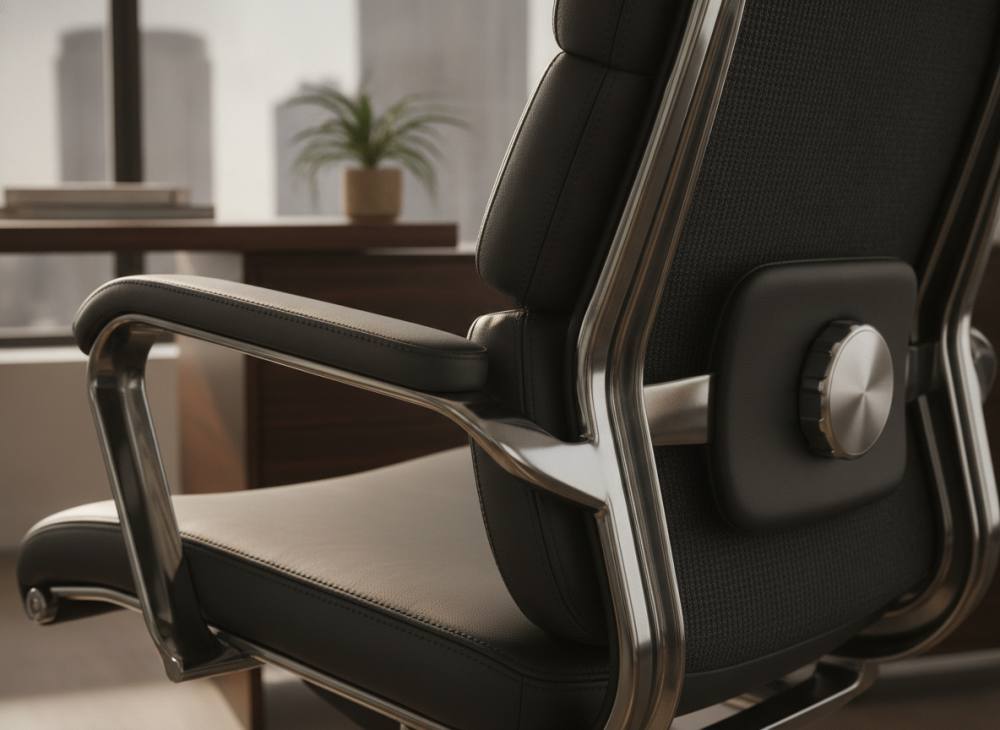
The natural inward curvature of the lower spine—the lordotic curve—experiences the greatest mechanical stress during prolonged seated work. An executive chair must supply targeted lumbar support that adjusts independently in both height and depth. Height adjustment ensures that the support pad aligns accurately with the third and fourth lumbar vertebrae, while depth adjustment controls the firmness of contact against the lower back. Lacking proper lumbar stabilization, users invariably slouch forward, placing severe shear stress on spinal discs and connective ligaments.
Cervical support is equally vital, particularly during contemplative intervals, video conferences, or telephone negotiations when leaning back. A dedicated headrest with height and angular pitch articulation supports the cervical vertebrae and base of the skull. This relieves chronic tension in the trapezius and shoulder girdle, mitigating the stiffness frequently experienced after continuous cognitive engagement.
Seat Depth, Width, and Multi-Directional Armrests
The seat pan cushion must adequately support the upper thighs without exerting compressive force on the popliteal region behind the knees. When sitting firmly against the backrest, an optimal seat depth leaves a clearance of roughly two to three fingers between the front edge of the seat and the back of the knees. Integrated seat-slider mechanisms allow users to adjust the cushion forward or backward, facilitating unimpeded blood return from the lower limbs.
In terms of width, the seat pan must accommodate the user comfortably without restricting hip movement or pressing against the armrest mounts. Furthermore, adjustable 3D or 4D armrests are indispensable. These components allow precise calibration of height, forward-backward stroke, lateral width, and axial rotation. Properly adjusted armrests support the forearms so elbows rest comfortably at a 90-degree angle, parallel to the desktop surface, entirely eliminating shoulder elevation and wrist strain.
Mechanisms and Motion Capabilities: Synchronous and Multi-Tilt Systems
The mechanical under-structure forms the operational core of any premium office chair. Basic single-lever tilt configurations that merely pivot from a central axis cause the front seat edge to rise when reclining, lifting feet off the floor and exerting pressure underneath the thighs. Executive environments require advanced movement hardware engineered for dynamic posture management.
Synchronous (synchro-tilt) mechanisms address this by coordinating the movement of the backrest and the seat pan at a measured ratio—typically reclining two degrees for every one degree of seat tilt. This dynamic geometric relationship keeps the feet firmly grounded, preserves spinal posture, and maintains regular pelvic positioning. Integrated tension-control adjustments allow fine-tuning of the reclining resistance based on individual user weight, facilitating smooth transitions between focused upright work and relaxed contemplation.
The pneumatic gas lift cylinder represents another critical mechanical checkpoint. Specifying Class 4 commercial-grade gas lifts guarantees reliable vertical travel, superior safety ratings, and long-term resistance to unintended sinking or pressure leaks under daily corporate operation.
Material Quality and Upholstery Options
The tactile surfaces and visual presence of an executive chair communicate the corporate values of the executive suite. Beyond visual appeal, upholstery selections must satisfy exacting requirements for thermal comfort, abrasion resistance, and routine maintenance.
Genuine Leather and High-Grade Synthetic Leather
Traditional and prestigious executive suites frequently incorporate genuine leather or premium polyurethane (PU) leather finishes. Authentic full-grain or top-grain leather offers natural micro-porosity, allowing gradual heat dissipation while developing an attractive patina over time. It provides a refined, distinguished presentation suitable for formal boardroom settings.
High-grade synthetic alternatives—specifically medical- or hospitality-grade PU textiles—deliver liquid resistance, stain repellence, and ease of disinfection without cracking. However, low-grade PVC vinyl finishes must be avoided, as their non-porous structure traps body heat and induces uncomfortable perspiration during warmer seasons.
Breathable Mesh and Technical Fabrics
Contemporary executive environments increasingly favor engineered mesh backs and woven technical textiles. High-tensile elastomeric mesh conforms precisely to the contours of the spine, distributing weight evenly and virtually eliminating localized pressure hotspots along the back. Constant air circulation through the open weave prevents thermal buildup, sustaining user alertness across long working sessions.
For the seat cushion, cold-cured molded foam with a density rating of at least 50 to 60 kg/m³ provides the ideal foundation. Unlike low-resilience cut foam, molded foam retains its elastic recovery and structural form over years of heavy usage, preventing bottoming-out against the inner shell.
Architectural Harmony: Coordinating with the Executive Desk and Room Concept
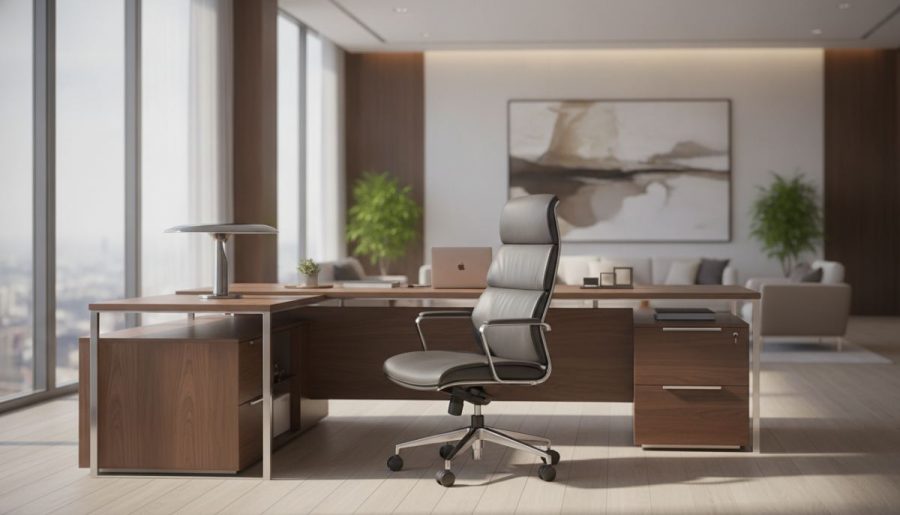
An executive chair should not be evaluated as an isolated element; it serves as a central architectural anchor within the broader office suite. The physical dimensions, backrest height, and visual weight of the chair must harmonize with the scale of the executive desk and the room circulation pathways. An excessively bulky, overstuffed model can overwhelm a compact private office, whereas an overly minimalist task chair can look insubstantial behind a grand, architectural desk.
Ensuring visual cohesion among storage credenzas, guest seating, architectural finishes, and lighting requires holistic interior planning. For a deeper examination of spatial proportion and stylistic unity, reviewing our guide to executive office interior decoration ensures that every furniture component reinforces corporate distinction.
Executive Chair Selection Criteria Comparison
The following evaluation framework summarizes key technical and functional criteria to analyze when procuring executive seating for corporate offices.
| Evaluation Criterion | Ideal Technical Specification | Impact on Ergonomic Comfort | Verification Method |
|---|---|---|---|
| Recline Mechanism | Multi-position lockable synchro-tilt mechanism | High (Maintains continuous spinal and pelvic alignment) | Test tilt angle range and lock rigidity under load |
| Lumbar & Cervical Support | Independently adjustable height and depth settings | High (Reduces compressive load on lumbar discs) | Verify mechanical glide range and contact stability |
| Armrest Articulation | 3D or 4D adjustments with soft-touch PU pads | Moderate (Relieves trapezius and shoulder strain) | Check vertical travel, horizontal stroke, and axial pivot |
| Seat Cushion Core | High-density cold-cured molded foam (50–60 kg/m³) | High (Prevents deformation and tailbone fatigue) | Assess rebound elasticity and compressive resistance |
| Base & Caster Assembly | Die-cast aluminum five-star base; floor-matched casters | Moderate (Ensures silent, smooth, and stable mobility) | Verify caster material suitability for floor surface |
Note: Primary technical datasheets and product certifications should be consulted for definitive verifications; no speculative metrics are included. Corporate spatial requirements should always be customized to specific room dimensions and functional demands.
Common Mistakes to Avoid When Purchasing an Executive Chair
- Prioritizing Sheer Bulk Over Mechanical Adjustability: Selecting oversized, heavily padded armchairs lacking multi-functional mechanisms often results in severe postural fatigue by the end of the workday.
- Mismatched Caster Specifications: Utilizing hard nylon casters on solid hardwood or polished stone causes surface scratching and uncontrolled sliding. Soft polyurethane-coated casters are required for hard flooring, whereas hard casters belong on carpeted surfaces.
- Overlooking Armrest-to-Desk Clearance: Fixed-height armrests frequently collide with the desktop modesty panel or pencil drawers, forcing the user to sit too far forward and slump toward the screen.
- Compromising on Seat Foam Density: Low-cost slab foam quickly collapses within months of continuous use, exposing the user to the rigid bottom shell and causing pelvic and coccyx pain.
Frequently Asked Questions About Executive Chairs
What is the core distinction between an executive chair and an operational task chair?
Executive chairs typically feature higher backrests, integrated or adjustable headrests, wider seat cushions, and premium upholstery materials designed for leadership offices. Task chairs, by contrast, feature more compact footprints intended for high-density open-plan offices and operational team workstations.
Is genuine leather or breathable mesh better for an executive suite?
The choice depends on workplace climate control and overall interior aesthetic. Genuine leather offers a distinguished, prestigious appearance suited to formal corporate boardrooms, whereas technical mesh provides superior thermal ventilation and ergonomic contouring for executives who work long, uninterrupted hours at a computer.
How should an executive chair be adjusted for ideal posture?
The seat height should be set so that the user's feet rest flat on the floor with knees forming an angle of approximately 90 degrees. When resting hands on the desk surface, shoulders should remain relaxed without shrugging, and elbows should rest at desk height.
What weight capacity should a commercial executive chair provide?
Commercial-grade executive chairs equipped with heavy-duty aluminum bases and Class 4 gas lifts are standardly tested to support between 110 kg and 125 kg under continuous commercial usage. For specialized heavy-duty needs, reinforced bariatric frames should be specified.
Making the Optimal Choice for Your Executive Suite
Furnishing an executive office requires a cohesive approach that balances corporate identity, enduring material quality, and active orthopedic support. Selecting seating that safeguards health while enhancing the visual presence of your management spaces is an investment in ongoing operational excellence. For tailored consultations, space planning assistance, and customized corporate furniture packages, please contact our workspace specialists to curate the ideal furnishing solutions for your enterprise.