08.11.2026
How to Identify Quality in Office Furniture: Buyer Guide
Evaluating commercial office furniture requires looking beyond surface aesthetics to understand structural integrity, material density, and mechanical engineering. A desk or task chair may present a sleek, contemporary appearance in a showroom catalog, yet fail prematurely under the demands of a high-traffic corporate workspace. True quality is determined by panel composition, edge-banding precision, connection hardware, and the mechanical resilience of moving components. Choosing well-built furniture protects corporate procurement budgets against recurrent replacement cycles while directly safeguarding employee physical health and reinforcing corporate brand identity.
Core Material and Structural Integrity Factors in Office Furniture
The load-bearing strength and operational lifespan of office desks, storage credenzas, and meeting tables stem directly from the core substrate utilized in their construction. In contemporary contract furniture manufacturing, the two predominant substrates are medium-density fiberboard (MDF) and high-density melamine-faced chipboard (MFC). For demanding commercial environments, panel boards should exhibit a uniform internal fiber distribution, adequate resin binder ratios, and compliance with low-emission E1 environmental standards. Lower-grade, loose-particle panels inevitably yield loosened fastener holes, sag under continuous load (creep deformation), and swell upon exposure to ambient humidity.
Surface finishing determines how gracefully a piece of furniture weathers daily wear, coffee spills, and frictional abrasion. Natural wood veneers offer an undeniable sense of prestige, executive authority, and tactile warmth, particularly when finished with durable polyurethane or UV-cured lacquers. Conversely, high-pressure laminates (HPL) and thermally fused melamines (TFM) provide superior resistance to surface scratches, UV fading, and routine cleaning chemicals. When selecting operational furniture, reviewing essential factors to consider when choosing office furniture prevents costly specification oversights before placing large-scale purchase orders.
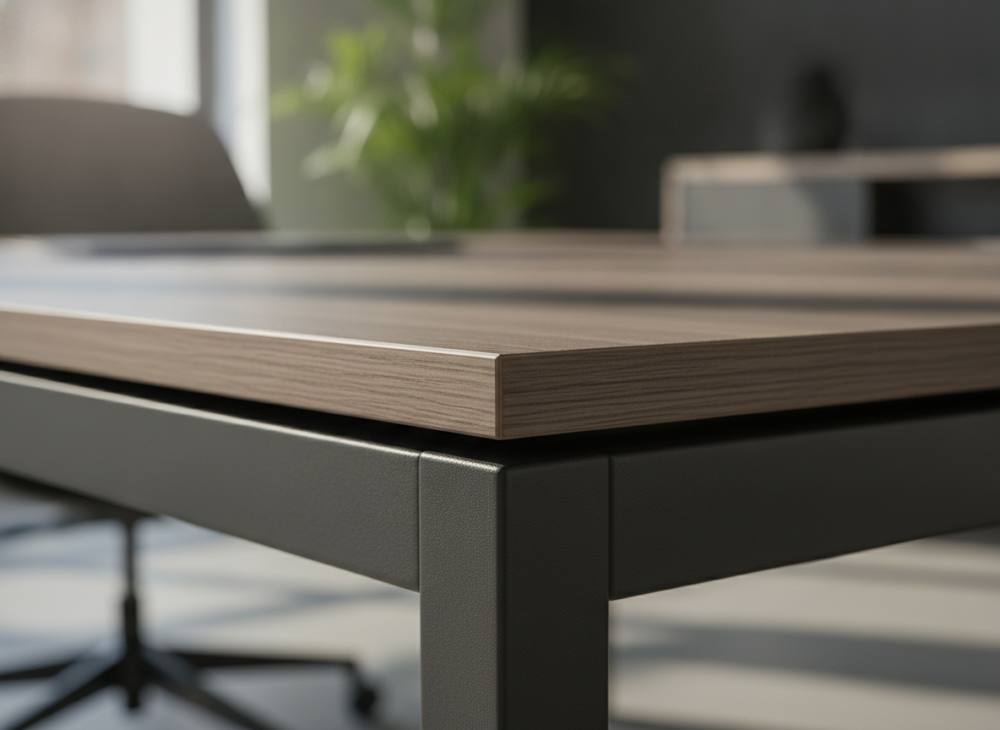
Edge execution serves as an immediate indicator of manufacturing discipline. Standard commercial panel edges should feature shock-resistant, through-dyed PVC or ABS edge banding with a thickness of at least 2 mm. The joint between the decorative surface and the edge band must be hermetically sealed with zero visible glue lines, gaps, or adhesive squeeze-out. Substandard edge tape allows moisture ingress over time, causing the underlying core material to blow out and permanently deform.
For steel structures, such as desk understructures, leg assemblies, and structural modesty beams, the wall thickness of the hollow metal sections is paramount. Heavy-duty structural frameworks utilize cold-rolled tubular steel with a wall profile of 1.5 mm to 2.0 mm, coated via electrostatic powder application. This electrostatic finish must undergo thermal curing in an industrial baking oven to create an impact-resistant, non-chipping surface that prevents unsightly scratches and structural wobble.
Testing Mechanism and Hardware Durability
In high-density work environments, dynamic mechanical hardware undergoes continuous operational stress. Drawer runners, door hinges, and gas lift cylinders are the components most susceptible to operational failure. Superior storage units utilize full-extension, heavy-duty telescopic slides or concealed under-mount drawer glides equipped with integrated dampening pistons. When opened under realistic document weight, high-grade drawer tracks glide linearly without horizontal play, lateral deflection, or metallic binding, closing gently without rebounding.
Cabinet doors require concealed, multi-pivot European hinges engineered with hydraulic soft-closing dampers. These pistons prevent concussive cabinet slamming, thereby isolating the primary carcass fasteners from structural shock and extending the working lifecycle of the unit. Furthermore, commercial furniture assemblies should prioritize zinc-alloy eccentric cam-and-dowel fittings (minifix connectors) backed by solid steel threaded studs rather than basic, glued wooden dowels. Rigid mechanical fittings permit repeated disassembly, reconfiguration, and corporate relocation without compromising structural joints.
In seating solutions, mechanical reliability directly determines occupant safety and posture support. The pneumatic height adjustment cylinder must meet recognized international classifications, specifically Class 3 or Class 4 commercial gas lift standards with seamless casing walls. Multi-functional synchronous tilt mechanisms must provide calibrated, body-weight-responsive tension adjustment alongside multiple locking tilt angles. Armrest supports should actuate crisply through vertical, axial, and lateral adjustments without excessive tolerance slack or squeaking.
Ergonomics and Functionality: Defining the User Experience
Robust construction alone does not make a product successful; anatomical compatibility and workday responsiveness are equally vital markers of quality. A structurally resilient workstation that induces chronic cervical or lumbar strain fails basic utility criteria. The universal benchmark for standard operational desk heights ranges from 720 mm to 750 mm above finished floor level. Desks should always incorporate integrated leveling glides beneath the leg columns to neutralize irregular commercial subfloors and eliminate desk tilt.
Effective cable management separates professional workstations from makeshift consumer desks. Premium desking integrates concealed flip-up access flaps, under-desk steel horizontal cable troughs, and articulating vertical cable spines. In open-plan settings, modern workstation desks consolidate shared network and electrical wiring within dedicated channels while providing specialized acoustic partition screens that preserve individual concentration.
Regarding task and executive seating, foam composition serves as the definitive test of durability. Low-density cut foam cushions lose elastic rebound within months of active use, bottoming out against the rigid seat shell. Commercial-grade seating incorporates cold-cured, injection-molded polyurethane foam rated between 45 kg/m³ and 60 kg/m³ density. This specialized molding process provides targeted pelvic support without permanent structural compaction. Upholstery textiles must also demonstrate elevated abrasion resistance under standard Martindale cycle testing, coupled with high-tensile, breathable mesh backings.
Distinguishing Quality in Executive Suites vs. Open-Plan Workspaces
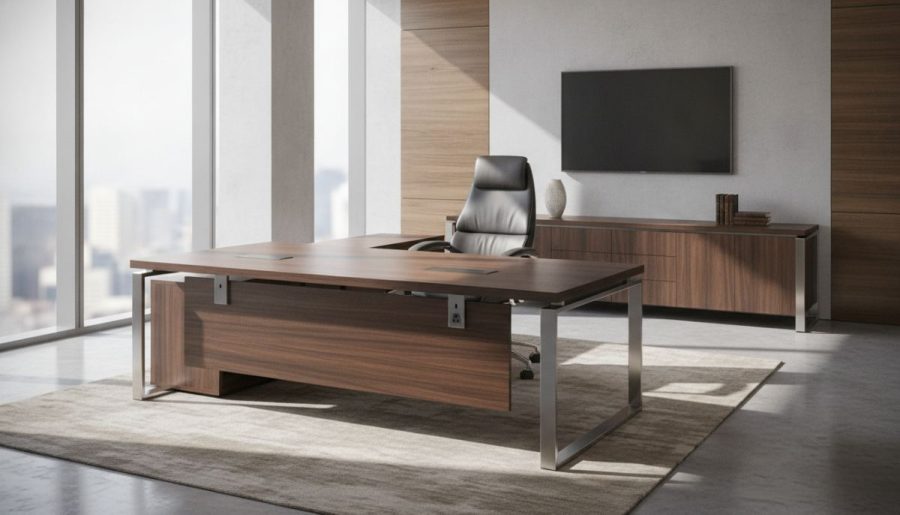
The criteria for assessing quality naturally adapt to the strategic role of each specific workplace zone. An executive office serves as a primary representation of corporate stability, authority, and brand prestige during high-stakes client negotiations. In premium setups, such as a curated vip executive office set, quality manifests in substantial desk profiles, flawless book-matched wood grains, integrated leather blotters, discreet internal wire routing, and precision miter joints. The presence of silent, push-to-open concealed drawers and artisan finishing confirms high production standards.
Conversely, in open-plan departmental bays, quality centers on scalability, component standardization, and relentless resistance to high traffic. Mobile pedestals must feature fifth-wheel anti-tilt stabilization casters to prevent tipping when top drawers are weighted. Breakout spaces and collaborative benches rely on scratch-resistant compact laminates, dent-resistant edge details, and stain-resistant commercial textiles. The objective in these environments is structural resilience against constant movement and daily repositioning.
Evaluation Criteria for Office Furniture Quality
A rigorous procurement strategy relies on systematic, physical inspections rather than marketing imagery. The following framework outlines verifiable criteria for assessing furniture durability and structural integrity prior to commercial installation:
| Evaluation Factor | Inspection Method | Quality Indicator | Durability Impact |
|---|---|---|---|
| Panel Density | Core cross-section inspection and fastener pull-out assessment | High-density E1 grade MDF or industrial-weight chipboard | High (Prevents shelf sagging and surface deflection) |
| Edge Banding | Perimeter visual check and seam separation test | 2 mm thick PVC/ABS tape with zero adhesive residue | High (Shields core substrate against moisture and impacts) |
| Steel Framework | Caliper measurement and surface scratch resistance check | Minimum 1.5 mm profile wall with cured electrostatic powder coat | High (Eliminates frame sway and lateral racking) |
| Moving Hardware | Repeated cyclic extension and soft-close engagement | Full-extension dampened slides and hydraulic clip hinges | Medium - High (Guarantees smooth, silent daily cycling) |
| Seat Cushioning | Indentation recovery and manual compression test | Cold-cured molded polyurethane foam (45-60 kg/m³) | High (Preserves ergonomic shape and prevents seat collapse) |
Note: Primary internal documentation, manufacturer specifications, or analytics should be used for exact measurements; no fabricated figures are presented here.
Common Procurement Mistakes and Strategic Solutions
A frequent mistake in corporate workplace outfitting is assessing furniture strictly through static 2D floor plans or discounted unit prices. Two desks sharing identical overall dimensions and surface decors can diverge dramatically in substrate density, hardware alloys, and frame rigidity. Substandard fittings often reveal their defects within months through misaligned cabinet fronts, noisy drawer glides, or wobbly desk frames.
Another recurring pitfall is failing to evaluate spatial clearance and ergonomic flow before finalizing specifications. Oversized desks squeezed into compact management suites constrict pathways, while deep credenzas can block circulation corridors or door swings. To avoid these issues, facilities teams should review full mockups, inspect physical material samples, and define precise electrical floor feed points well before placing volume orders.
Frequently Asked Questions
How can you differentiate MDF from particle board in finished furniture?
MDF consists of finely pulverized wood fibers pressed into an exceptionally dense, smooth mass, making it significantly heavier and more resistant to edge chipping. Particle board (chipboard) features visible wood chips and granular particles layered between thinner surface skins. In finished products, inspect exposed cutouts, such as cable grommets or the underside of the work surface, to identify the core density and composition.
What should I look for when testing an ergonomic task chair?
Check that the height-adjustment piston actuates smoothly without sudden drops, verify that the synchronous recline mechanism locks securely across multiple positions, and confirm that the lumbar support aligns with your lower back. The seat cushion should instantly rebound when you stand up, and the rolling casters must travel cleanly across your specific floor surface without catching.
Why is high-grade PVC edge banding critical for corporate desks?
The edges of a desk experience constant friction from chairs, personal accessories, and cleaning equipment. A 2 mm commercial-grade PVC or ABS edge absorbs mechanical shocks that would otherwise shatter brittle surface coatings. It also acts as an impermeable barrier against airborne moisture, spilled liquids, and cleaning detergents that can cause core substrate expansion.
What components should a comprehensive commercial furniture warranty cover?
A legitimate commercial warranty should explicitly cover core structural elements, including metal frame welds, desk understructures, mechanical drawer tracks, cabinet hinges, and pneumatic gas cylinders against manufacturing flaws. Reliable manufacturers also maintain spare parts availability, ensuring that individual components can be serviced or replaced without discarding entire suites.
Tailored Solutions for Corporate Office Projects
To inspect material samples firsthand, verify technical specifications, and collaborate on space planning for an upcoming office renovation or expansion, contact our team to discuss durable, professional furniture solutions designed for lasting performance.